

The following is informational and not intended as medical advice. Older adults should always consult with a physician before starting or changing a fitness/exercise routine.
When most people think about strength training – which research has established is a vital component of healthy aging – their minds turn to racks of free weights and rows of circuit machines at a gym.
That equipment is great for many people. But some people have difficulty accessing it for any number of reasons, including availability (having a gym nearby), cost (memberships can be pricey), and even convenience (fitting regular trips to the gym into a hectic schedule).
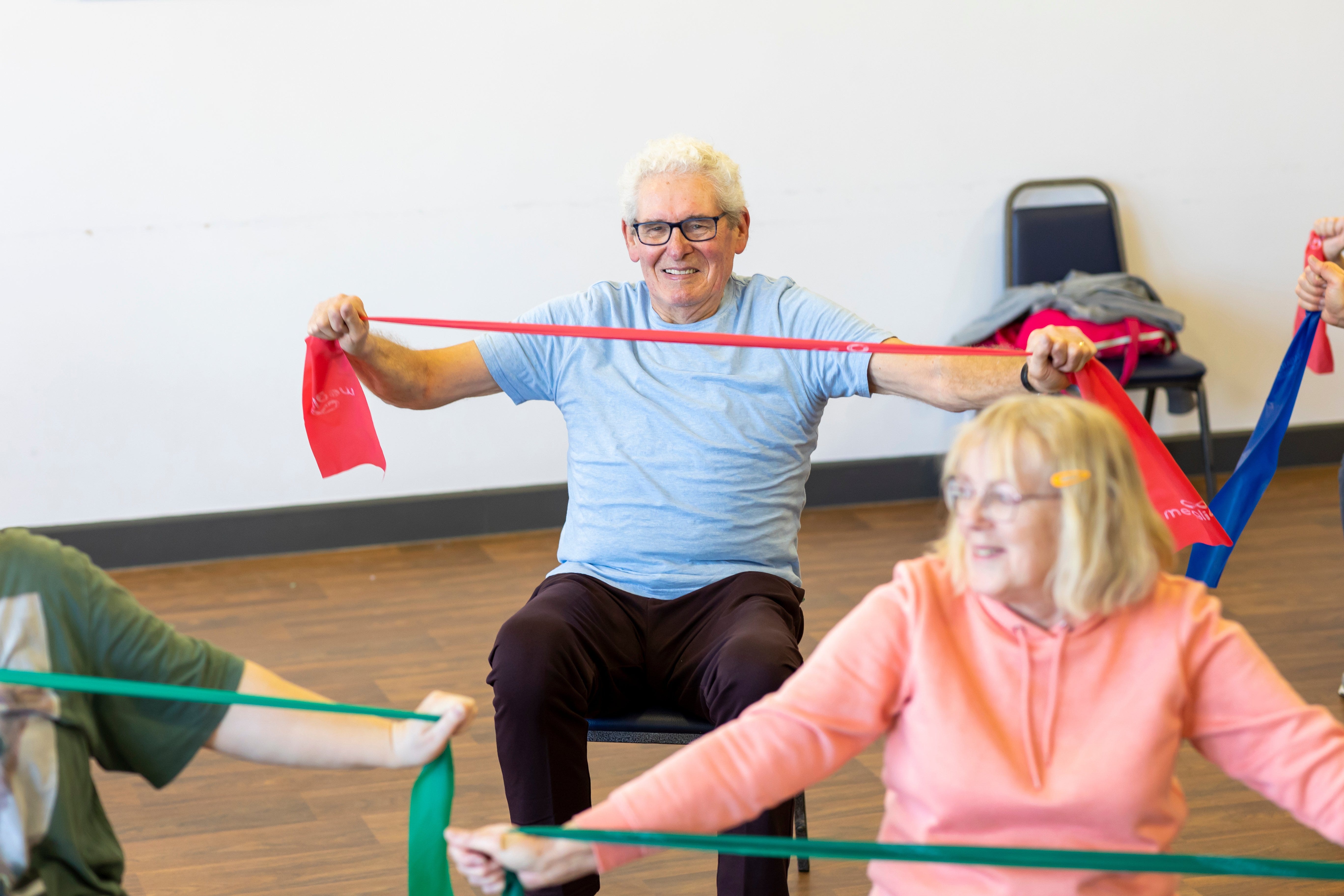
Fortunately, a simple and convenient alternative exists in the form of elastic resistance bands. This exercise equipment is inexpensive, portable and requires minimal space, which makes it perfect to keep at home, and even bring along when traveling.
Resistance bands come in a few different options, most commonly either:
A single length of stretchy material.
A closed loop that resembles a giant rubber band.
A thin rubber tube with handles.
They’re often color-coded for different amounts of resistance.
Bands as good as weights
As for effectiveness, workouts with elastic bands have been found to be as good as other methods for building strength.
An article from the Cleveland Clinic calls bands “easy to use, extremely versatile and powerfully effective.” It goes on to cite the following advantages for using bands as a workout device:
Adaptability, meaning the ability to vary workouts on the fly by changing movements to challenge muscles in different ways. Exercise bands allow the user to increase or decrease resistance simply by shortening or lengthening the band.
Portability. Resistance bands take up little storage room at home, and can easily fit in luggage to let you work out wherever you are.
Cost. A decent set of resistance bands costs about $25.
Their light weight and low-impact nature also makes them safer than weights, leaving users less susceptible to injury. That may be why they are also popular options for physical training during injury rehab.
Research validates bands’ effectiveness
Perhaps best of all, medical research supports the idea that band exercises can be as effective as other types of strength training, especially for older people: A piece of just-published research (from November 2025) concluded that “elastic band resistance training appears to be a feasible intervention for improving lower limb strength and balance function in older adults with different health conditions.”
Other studies with evidence about the value of bands include:
A systematic review and meta-analysis from 2019, which examined and summarized several pieces of research on the topic and concluded that “resistance training with elastic devices provides similar strength gains when compared to resistance training performed from conventional devices.”
Another study, from 2020, which reported an exercise program with elastic bands brought “significant physical benefits in sedentary older women.”
A 2022 study that focused specifically on older people with sarcopenia (age-related muscle loss) and found that “moderate-intensity resistance training in the form of an elastic band may be the best training prescription for elderly sarcopenia patients.” The best results were found from training for at least 12 weeks, with 40 to 60 minute sessions three or more times a week.
Bottom line: anyone who has avoided taking up a strength-training program because of an inability (or at least difficulty) of getting to a gym with the proper equipment can likely get as good of a workout from convenient and inexpensive elastic resistance bands.
Suggested elastic band workouts
Commonly recommended exercises with bands include:
Chest press. Wrap the resistance band behind your back, holding both ends with your hands. Starting with your arms at your side and elbows bent, push the band out in front of you as you straighten your elbows, and hold for one second.
Biceps curl. While standing, step on the resistance band. With your arms at your side holding the band, draw up your hand by bending at the elbow and hold for one second. Keep your palms facing upward the entire time.
Triceps extension: Stand on the band with your feet together or hip-width apart. Hold one end of the band with one hand and the other end with the other hand near the back of your head. Keeping your elbows close to your head, extend your arms overhead and then bend them to lower the band behind your head.
Pull-downs. Hold a band over your head with your hands about 12 to 16 inches apart. Bend your elbows and pull your hands down, stretching the band, to about chest level. Slowly raise your arms back overhead to the starting position.
Rows. Attach the resistance band securely to a door by pinching it in while closing the door, or wrap it around a solid upright such as a stair bannister. Holding the band with both hands, draw back the band as you bend your elbows. Keep your elbows near the side of your body.
Squats. Stand on the resistance band and grab both ends with your hands. While standing in a squatted position and holding the band, extend your knees up to a standing position. Lower back down and repeat.
Clamshells. Lie on your side, one leg on top of the other with your knees slightly bent. Loop a resistance band around both thighs. Keeping your feet together, lift your top knee. (The motion should look like a clamshell opening.) Switch sides after each set.
A workout should consist of two or three sets of 8 to 15 reps, done twice a week.
Sources: Cleveland Clinic and Harvard Health.