Physical activity benchmarks for older people
Here's how much exercise and what kinds are recommended by health authorities

Common sense, and research, say that keeping physically active is part of healthy aging.
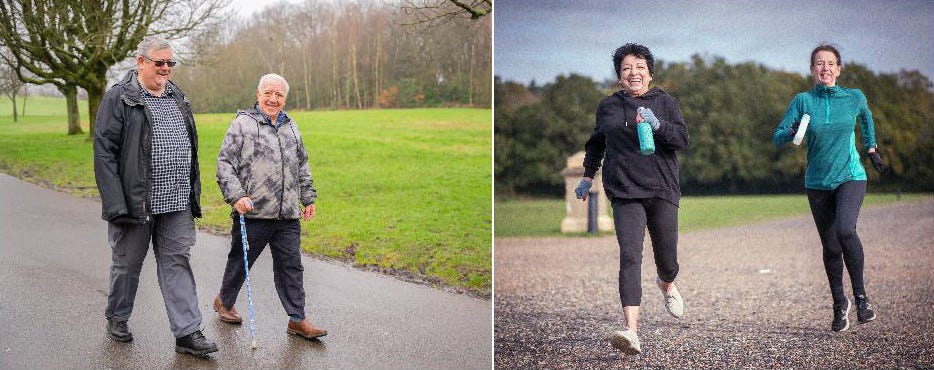
But HOW active? Public health organizations including the U.S. Centers for Disease Control and the World Health Organization provide some guidelines and benchmarks for that.
The CDC and WHO both say that every week, all adults (but especially those 50 and older) need:
At least 150 minutes of moderate-intensity aerobic activity, or 75 minutes a week of vigorous-intensity aerobic activity, or an equivalent mix of the two.
At least two days a week of activities that strengthen muscles.
Activities to improve balance.
Aerobic guidelines
Common ways to get moderate activity are brisk walking or easy bike riding, as long as it is enough to elevate the heart rate somewhat. Some daily activities such as housework, gardening or carrying groceries can have the same effect. Vigorous activity raises the heartbeat even further with activities such as hiking, jogging, biking over hilly terrain, or heavy-duty yard work.
The CDC also offers these guidelines for measuring intensity:
On a 10-point scale, where sitting is 0 and working as hard as you can is 10, moderate-intensity aerobic activity is a 5 or 6. It will make you breathe harder and your heart beat faster. You’ll also notice that you’ll be able to talk, but not sing the words to your favorite song.
Vigorous-intensity activity is a 7 or 8 on this scale. Your heart rate will increase quite a bit, and you’ll be breathing hard. You won’t be able to say more than a few words without stopping to catch your breath.
The 150 minute guideline could be met with moderate activity for 30 minutes a day on five days a week, or 22 minutes a day for all seven days. To mix and match activity levels, it may be helpful to use a “points” system, in which a minute of moderate exercise is worth 1 point and a minute of vigorous work worth 2 points, with a goal of reaching 150 points. Some fitness trackers that count aerobic minutes measure pulse then use that formula.
It also doesn’t need to be all at once. Park a little further from the store the next time you’re shopping and walk really briskly across the lot to get a few minutes of moderate-level exercise.
Strength and balance training
Strength training involves activities that use resistance to work major muscle groups including legs, hips, back, chest, abdomen, shoulders, and arms. Exercises should should cover all of those muscle groups and each should be done to the point where it’s hard to do another repetition without help. Routines typically consist of at least one set of about 8 to 12 repetitions to reach that exhaustion level; for more benefits, two or three sets can be done.
Going to a gym for access to free weights or machines is a common approach to strength training, but it’s not really necessary. Working with resistance bands, body-weight exercises and even some forms of yoga will build strength also. The important thing is to have a variety of exercises to hit all of the muscle groups.
Balance is especially important in older adults to help prevent potentially damaging falls. The most common exercise to improve static balance is just standing on one leg at a time for up to 30 seconds. Yoga poses such as “tree” and “warrior 3,” both of which involve one-legged stands, also are good balance practice.
Coordination exercises to improve dynamic balance – keeping balanced while moving – include heel-to-toe walking on a straight line and sideways walking, either straight or while crossing the legs over each other. Strengthening back, core and leg muscles also improves balance.
Another good option for older adults looking to improve fitness are so-called “multicomponent” routines, such as yoga (with strength and balance poses) and some circuit training that has both strength and aerobic components.
Many don’t meet the guidelines
Only a minority of people actually meet the guidelines, according to surveys on the topic.
A report from the National Center for Health Statistics said that in 2020 about 47 percent of all adults met the aerobics guidelines and 31 percent met strength-training guidelines. But only about 24 percent met standards for both aerobics and muscle-strengthening, and nearly half -- 46 percent -- met neither.
Even smaller numbers of older adults meet the standards. Only 22 percent of men ages 50–64 and 15 percent of men 65 and older met both aerobic and strength-training guidelines, while only about 18 percent of women ages 50–64 and 11 percent of those 65 and older did.
For anyone wondering “how much is enough?” when it comes to exercising, these criteria offer some guidance.
Finally …
Happy Veterans Day to all of those who served, and to their families who often suffered hardships of their own while loved ones were away doing their duty. Thank you to all!